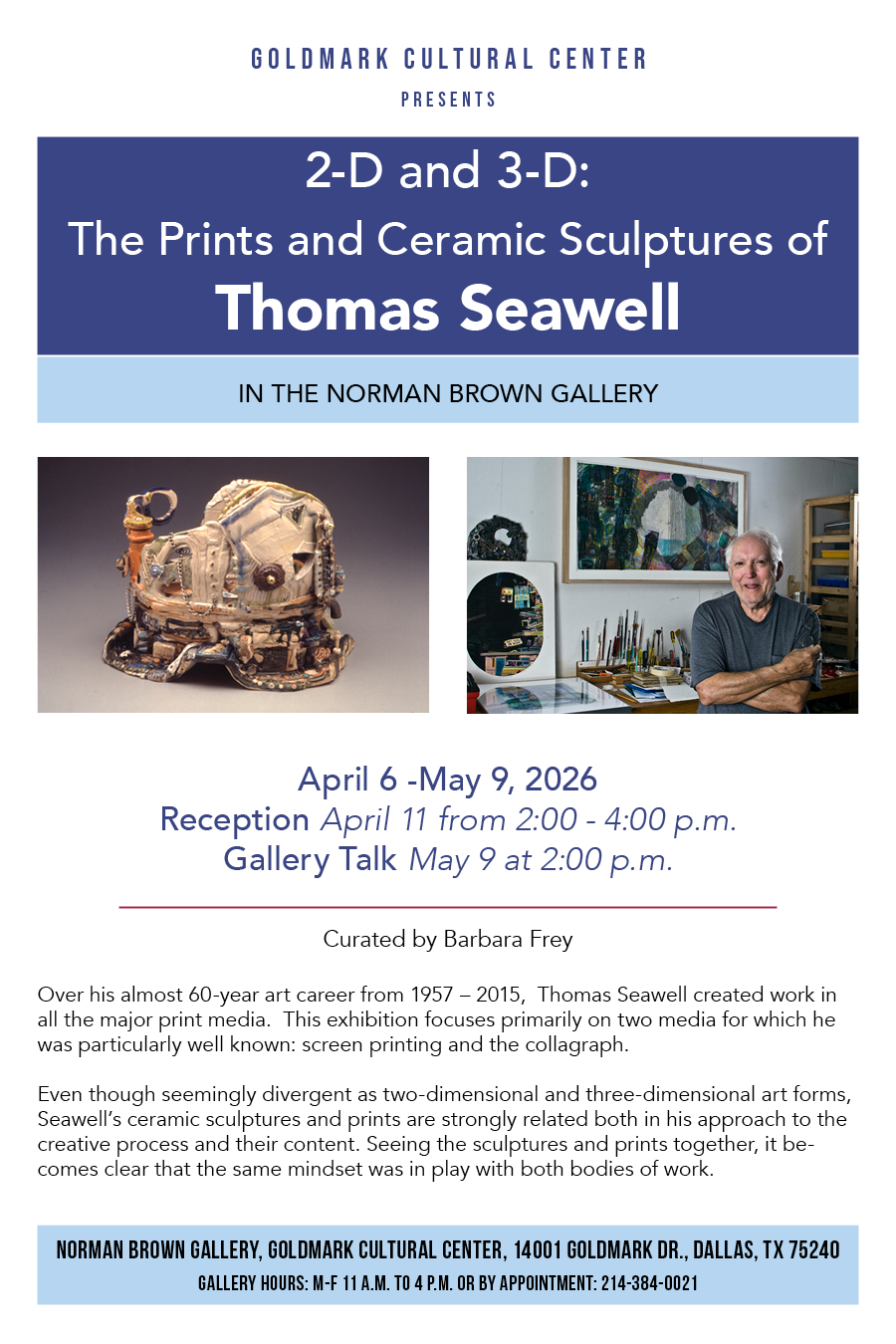
The Goldmark Cultural Center’s Norman Brown Gallery is proud to present “2-D and 3-D: the Prints and Ceramic Sculptures of Thomas Seawell”, a solo exhibition featuring ceramic sculptures, screen printing, and collagraphy by artist Thomas Seawell, curated by Barbara Frey.
The exhibition is on display in the Goldmark Cultural Center’s Norman Brown Gallery from 6 April 2026 to 8 May 2026. The exhibition’s reception date is on Saturday, 11 April 2026 from 2:00pm to 4:00pm. The reception is a great opportunity to view the exhibition and to learn about Seawell’s artwork.
About the Exhibition
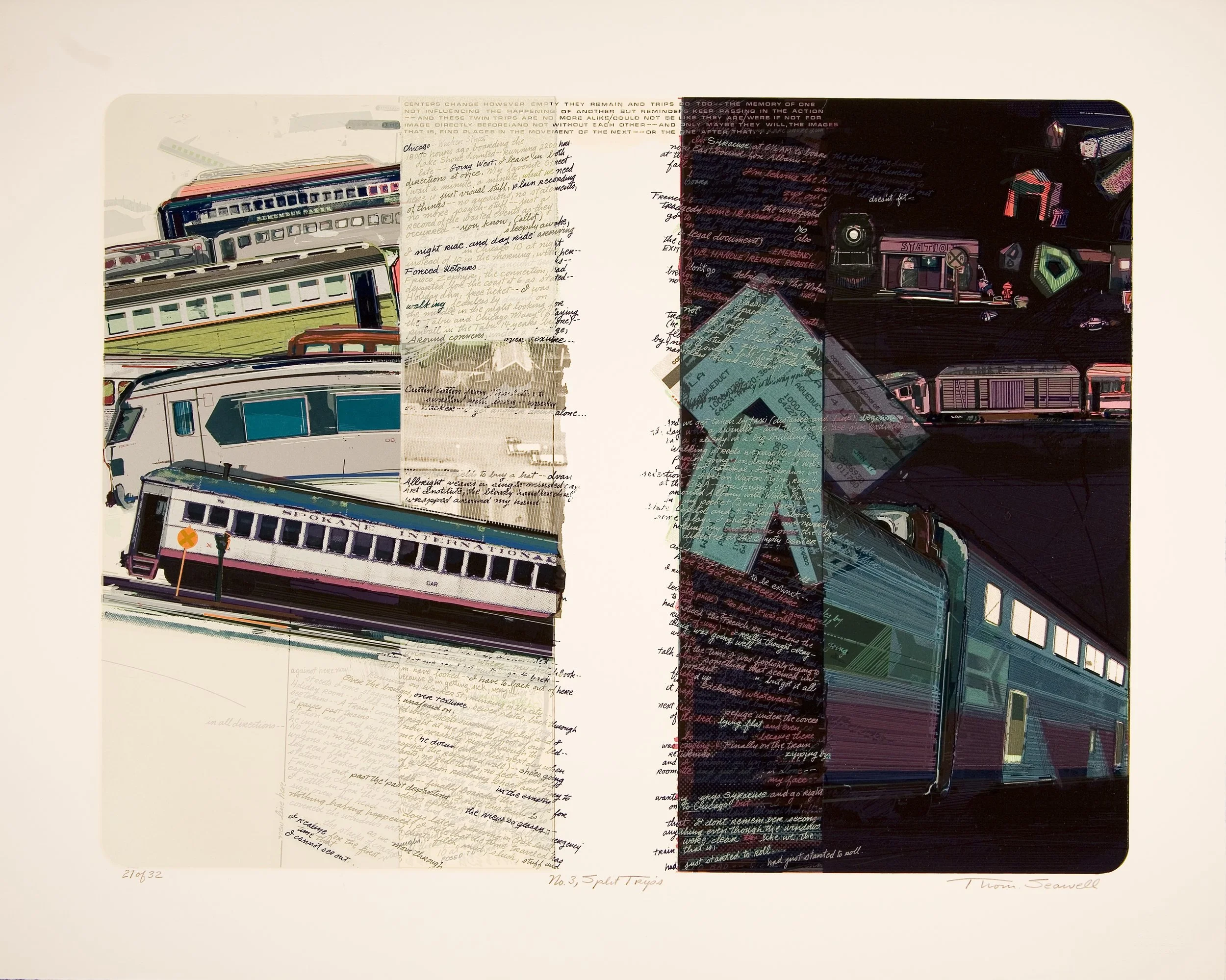
Over his almost 60-year art career from 1957 – 2015, Thomas Seawell created work in all the major print media. This exhibition focuses primarily on two media for which he was particularly well known: screen printing and the collagraph. The screen prints in the exhibition are representative of four different series: the Empty Centers suite, the Art Doors project, stock exchange prints commissioned by Geldermann Inc, Chicago, and Variations on Themes of Jacques Callot. Thomas Seawell is recognized in the history of printmaking as an early practitioner of the collagraph. His earliest efforts date from 1957 as an undergraduate art student at Washington University-St Louis. Before the term collagraph became the accepted name for this process of constructing a plate, he called his creations “fiberboard prints”, referring to the particular substrate he used as his starting point. The use of collagraphy in this exhibition focuses on Seawell’s method of creating collagraph plates that are shaped as identifiable objects. Thom called these plates his “actors” and considered the picture plane to be the stage upon which he could arrange them in different ways to created dramatic narratives.
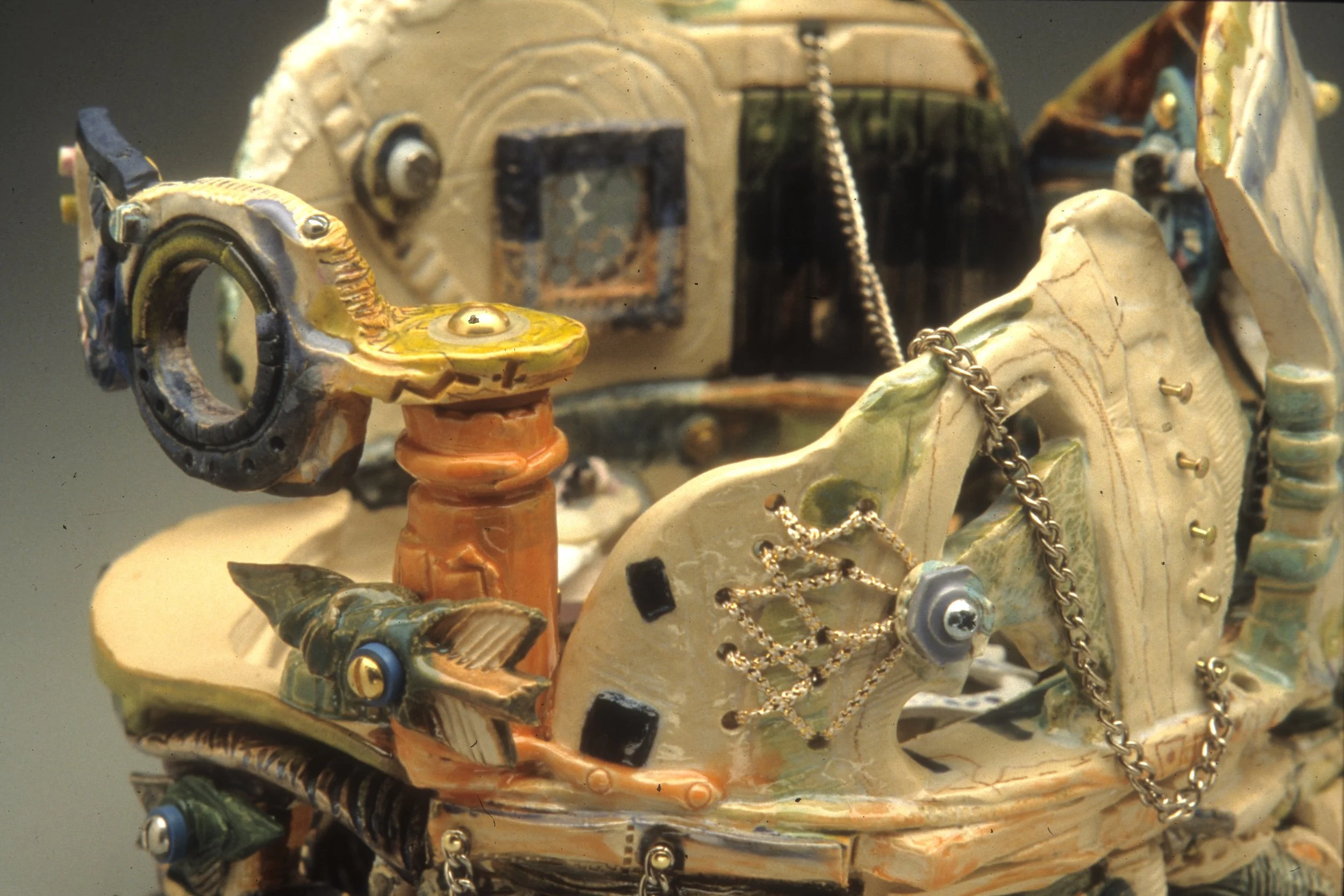
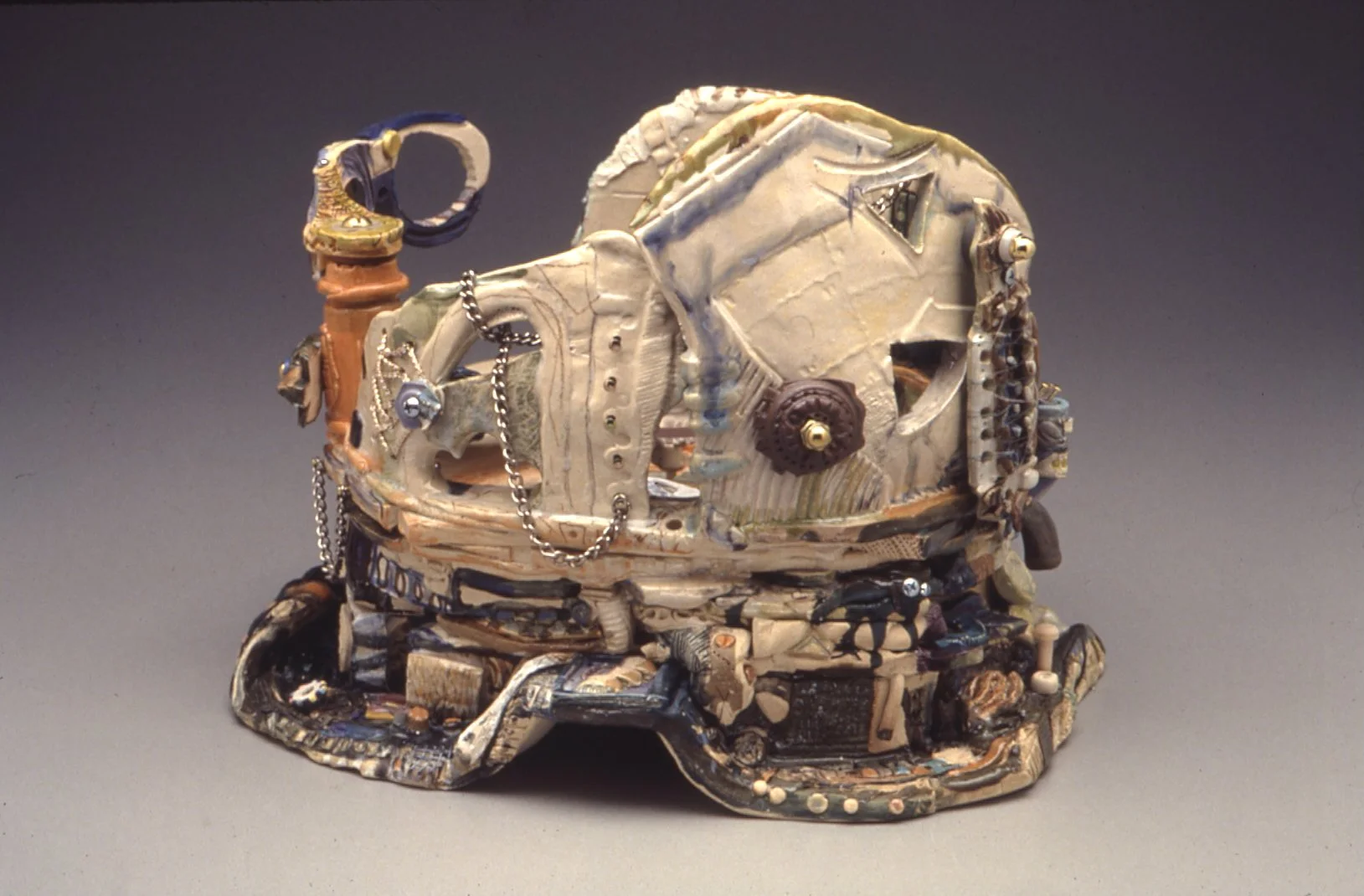
Even though seemingly divergent as two-dimensional and three-dimensional art forms, Seawell’s ceramic sculptures and prints are strongly related both in his approach to the creative process and their content. Seeing the sculptures and prints together, it becomes clear that the same mindset was in play with both bodies of work. The layering of imagery evident in the prints is also distinctly present in the sculptures. The ceramic pieces have gone through the customary clay processes of construction, surface embellishment, and firing but this is just the starting point; a significant amount of work takes place post-firing. The roster of added materials and objects includes a wide range of hardware, Plexiglas panels, photographs, screening, and paint, added in an improvisational approach until critical mass had been achieved.
Artist Statement
“My attempts at understanding and communication are in the form of invented visual dramas that I want to operate both abstractly and literally. I like the print for this purpose because it can be intimate, conceived in personal craft, and can have an isolated and stilled quality about it.
I am first an abstract composer. The goal of the way that I choose to position things, use space, and use scale, is dramatic structure. My final evidences, however, can never escape my preoccupation with things and so they always have a not quite exact top layer of literalness. I draw and use photographs of many objective things which I, in turn, use in potpourri fashion. I always hope that the total is mindful drama to which response can occur on many levels.”
-Thomas Seawell
“Seawell’s use of the serigraphic medium is of uncommon interest. He layers the inks intricately to give effects from high gloss to mat, all with intensity of hue and evenness of value. His orchestration of the medium’s potential finishes and his use of ink in all degrees between opacity and transparency are exemplary. Seawell prefers to work in intimate sizes and human scales; his images are to be examined rather than confronted. He treats his surfaces with a varnish, which accentuates the character of the various finishes he has used and restores some surface evidence of former printings.”
-Gene Baro from the catalog 30 Years of American Printmaking, The Brooklyn Museum, 1976
About the Artist
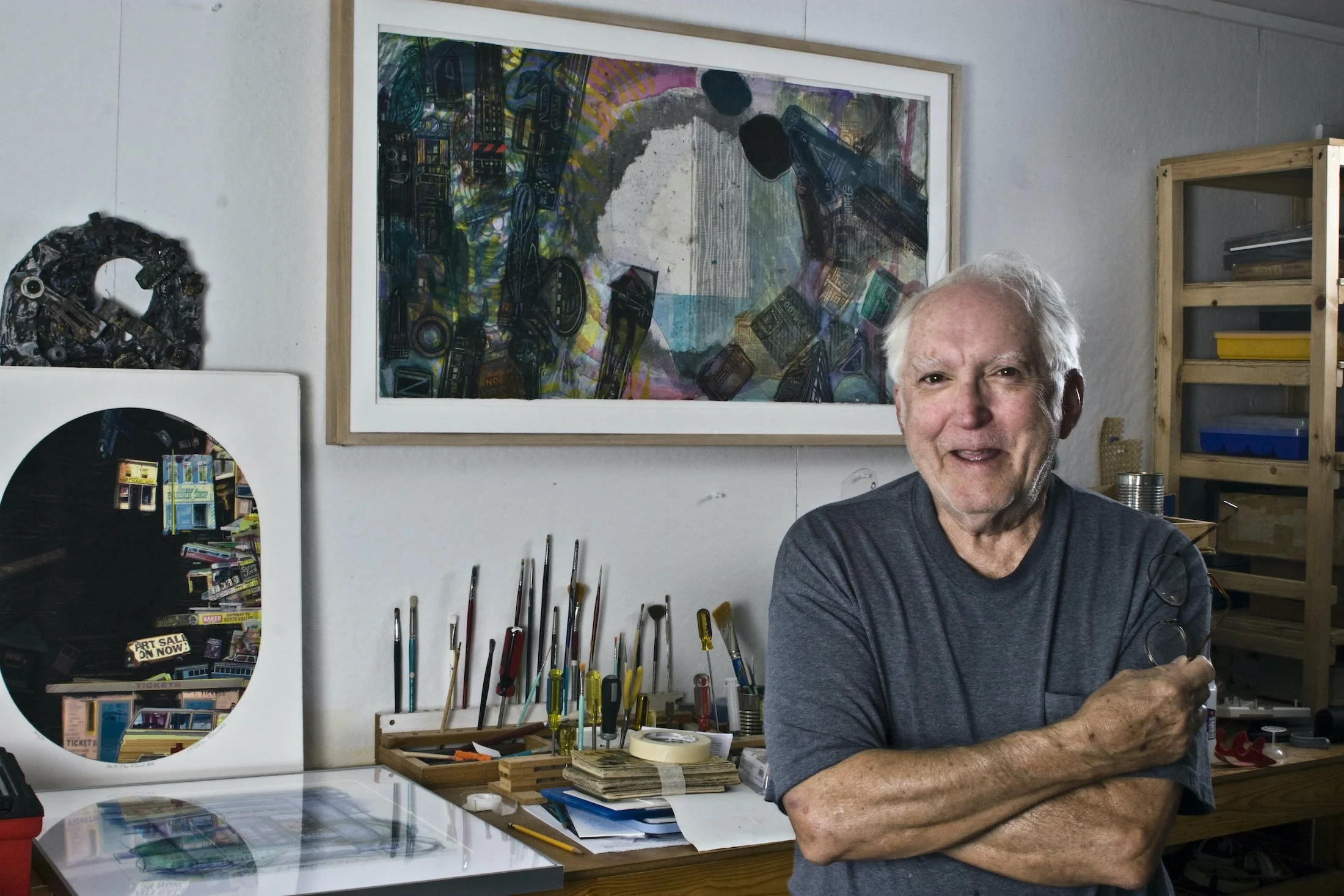
Thomas Seawell (1936-2015) received his art education at Washington University St Louis and Texas Christian University. In 1963 he was hired by the State University of New York College at Oswego to establish a fine art print program. He taught there until his retirement in 1991. From 1991 through Spring 2014, he taught screen printing and beginning printmaking classes as an adjunct instructor at East Texas A&M University-Commerce.
Mr. Seawell was a very prolific artist, producing work in all printmaking media over his long career. He was particularly well known for his screen prints and collagraphs. He has been recognized as one of the earliest practitioners of the collagraph medium, experimenting with what he called “fiberboard prints” in 1957. He was also an accomplished photographer and used photography extensively in his prints. His ceramic and mixed media sculptures dislay a distinct kinship with his prints, both in his approach to the creative process and through their content.
Seawell’s work has been widely exhibited and can be found in many public, private, and corporate collections including the Library of Congress; the Brooklyn Museum; The Smithsonian American Art Museum; The National Gallery of Art; the deCordova Sculpture Park and Museum; the Pushkin Museum of Art, Moscow; the Portland, Oregon Museum of Art; San Francisco Museums of Art and the Memorial Art Gallery, Rochester, NY. His work has been published in numerous books on printmaking. He was invited by both private and institutional presses to produce editions of prints including the Print Club of Albany, the Rochester Print Club, Nyle Press in Brooklyn, and the Matrix Program of the University of Dallas.
Thom Seawell’s work is archived in the Artist Printmaker / Photographer Research Collection at The Museum of Texas Tech University. The AP/RC contains extensive collections of original prints and related research materials of select 20th and 21st century artist-printmakers.
The Collagraph
The print medium of Collagraphy dates from the mid 1950’s. A collagraph plate is essentially a constructed collage created from a variety of textured materials glued to a rigid substrate such as matt board. Various textures will hold different amounts of ink, thus creating a value range. Collagraph plates may be inked and printed intaglio or relief, or both. Thom Seawell explored the collagraph medium in a variety of ways, including combining the collagraph with silk screen printing, relief printing, and printing on handmade paper. He referred to his collagraph plates as “actors,” and approached the picture plane as a stage where he could arrange and direct his “actors “in dramatic relationships and narratives.
Quisque iaculis facilisis lacinia. Mauris euismod pellentesque tellus sit amet mollis.